
Every strong product starts with a well-made part. Whether it is used in a vehicle, machine, electronic device, or industrial system, the quality of each component affects how the final product performs.
This is why high pressure aluminium die casting is widely used in modern manufacturing. It helps produce parts that are lightweight, strong, accurate, and consistent. For industries that need dependable aluminium die casting parts, this process offers a practical way to create complex components at scale without compromising quality.
The idea is simple, but the execution requires experience. Molten aluminium is injected into a mould under high pressure, allowing manufacturers to form detailed shapes with good strength and accuracy. When the process is properly controlled, the result is a part that performs well in demanding applications.
What Is High Pressure Aluminium Die Casting?
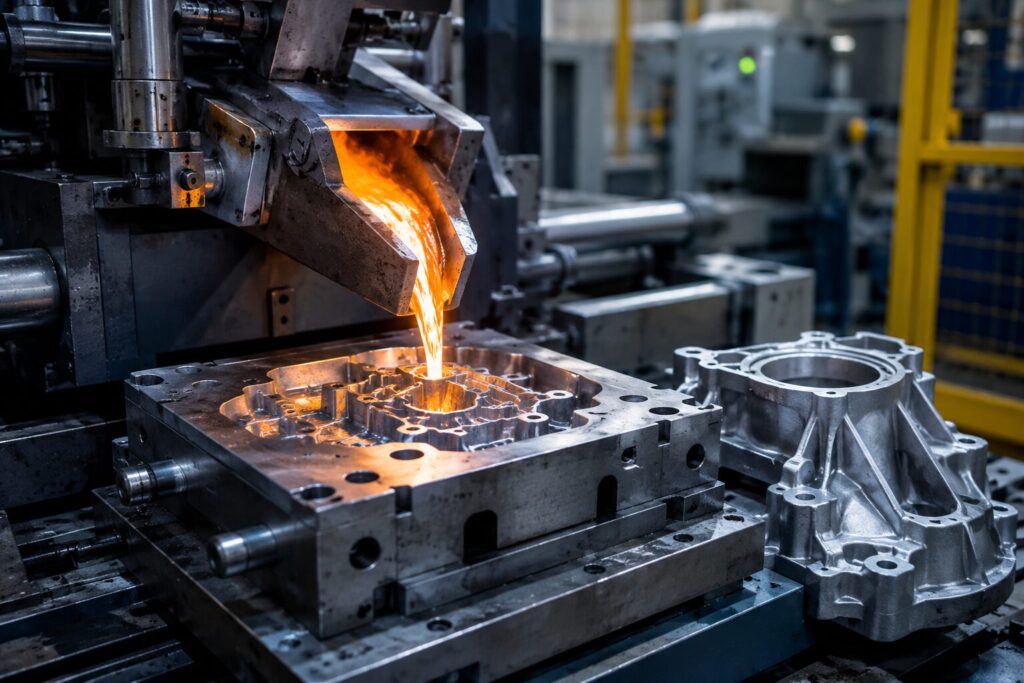
High pressure Aluminium Die casting is a process in which the molten aluminium alloys are forced at high speed and pressure into a steel mould. The mould takes the shape of the part and when the aluminium cools and solidifies it creates the required part.
It is typical for use when parts must be manufactured in large numbers and in a high standard of quality. It is also suitable for parts with complex shapes, thin walls, smooth surfaces and precise dimensions.
In layman’s terms, high pressure aluminium die casting enables manufacturers to accurately and repeatedly manufacture aluminium alloy parts quickly and with ease.
Understanding the Aluminium Die Casting Process
The aluminium die casting process involves several important steps. Each step plays a role in the strength, shape, and final quality of the part.
1. Mould Preparation
The mold is cleaned, inspected, and set up in advance of casting. Generally the lubricant is provided to facilitate proper flow of the molten aluminium and ease the release from the finished part.
This stage is a simple one but very crucial. A well-prepared mould minimises defects and facilitates the production process.
2. Melting the Aluminium
The aluminium alloy is then heated until it is melted. The choice of aluminium alloy will vary depending on the part’s use and performance requirements.
For some parts, stronger parts properties are required, and for others good corrosion resistance, thermal property or machinability properties are required. The selection of material is one of the first steps towards the manufacturing of reliable aluminium components.
3. High-Pressure Injection
When the aluminium is ready, it’s pressed into the mould at high pressure. The pressure facilitates rapid and uniform filling of the mould including fine detail and thin sections with the molten aluminium.
This is why it’s a good process for intricate and complex pieces. The high pressure also helps to ensure part density and dimensional accuracy.
4. Cooling and Solidification
Once the mould is full the aluminium starts to cool and harden. The cooling stage needs to be accurately controlled, as it may impact the quality, strength and stability of the part.
If the cooling is not controlled properly, the product may experience problems like shrinkage, porosity or uneven surfaces. The part with the correct process setting can have more consistency and performance.
5. Ejection and Trimming
The aluminium is allowed to set in the mould and then removed. This is where additional material may be added to the casting, such as flash, runners or gates.
These are cut off to ensure that the part is the desired shape and ready for the next step.
6. Finishing and Quality Check
After trimming, the part may go through additional processes such as machining, surface finishing, leak testing, impregnation, painting, or assembly. These value-added services help ensure that the final part meets customer requirements.
Quality checking is also essential. For high-performance aluminium die casting parts inspection helps confirm that the component meets dimensional, functional, and visual standards before delivery.
Why Aluminium Is Commonly Used for Die Casting Parts
Aluminium is a common material due to its combination of strength, weight and flexibility. Has a low density but is at the same time strong enough for various industrial applications.
It also has good corrosion resistance and thermal conductivity, which is beneficial for parts that require heat resistance, mobility, or outdoor use. Aluminium can also be shaped in complex designs, providing the engineers greater freedom in the design of new components.
Aluminium is also suitable for manufacturers for larger production quantities. It can assist in losing weight, increasing efficiency and maintaining uniform production. Another benefit is that aluminium can be recycled, making it a more sustainable material to use for a lot of industries.
How the Process Creates High-Performance Aluminium Die Casting Parts
The performance of a part is not only dependent on material. It also relies on the process control.
High pressure die casting is the method of forcing the aluminium into the mould under sufficient pressure to be able to fill the mould with intricate details and thin cross-sections. This assists to produce parts that are more precise and uniform.
Tight tolerances are also maintained with a good mould design. This is crucial when the part is required to be fitted into a bigger assembly or operate with other mechanical elements. Failure to get the dimensions right will result in problems with the finished product.
The process also ensures repeatability. After preparation of the mould and production setting, the same parts can be produced again and again with stable quality. This is helpful for industries that require components that are strong and can be used in bulk.
Another benefit is the surface finish. Many die cast parts are finished with an intentionally similar smooth surface, thus minimizing additional finishing operations. Complex shapes can also be formed in one piece, rather than from multiple pieces.
Common Applications of Aluminium Die Casting Parts
Aluminium die casting parts have a wide range of applications.Here are some common uses for aluminium die casting parts.
Aluminium die casting parts are used in a wide range of industries due to their strength, light weight and accuracy.
They might be applied in the automotive sector to housing, brackets, covers and mechanical parts. Aluminium die castings are commonly utilized in electronics and telecommunication for enclosures, heat-related components and protective casings.
These are also present in industrial machinery, automation, lighting, flow control equipment, furniture hardware and consumer goods.
Aluminium die casting is ideal for companies such as Teknicast, where precision parts of consistent quality and reliability are essential to their industry.
Benefits of Using High Pressure Aluminium Die Casting
For manufacturers and product developers, there are a number of advantages of high pressure aluminium die casting.
It is efficient in the manufacture of medium to high volume parts. When mould is produced it can be repeated without deviation. This contributes to minimizing part variation and quality control.
The method also enables the creation of complex designs with good accuracy. This can save time and cost in the long run, as it can minimize the need for additional machining or assembly.
One of its other very big advantages is the strength-to-weight ratio. Aluminium die casting parts can be manufactured with high strength and lightweight properties to meet the requirements for individual applications. This is particularly beneficial in weight reduction, durability, and accuracy industries.
Factors That Affect Die Casting Quality
Making quality aluminium die casting is not simply about having molten metal and pouring it into a mould. There are numerous details that have to be handled properly.
The aluminium alloy needs to be based on the application of the part. The mould has to be designed correctly to allow the molten aluminium to flow freely and to cool the piece evenly. The final result is also influenced by the injection pressure, injection speed, cooling time and machine accuracy.
The four main processes of casting, trimming, machining, finishing and inspection are equally important after casting. A small problem in any part of the process can have an impact on the part’s performance, appearance or fit.
That’s why it’s important to experience it first-hand. A trustworthy die casting manufacturer ought to be familiar with the production process and the requirements of all fields.
Choosing the Right Aluminium Die Casting Manufacturer
Choosing the right manufacturer can make a big difference to the final product. A good supplier should be able to support more than just casting. They should understand design requirements, material selection, process control, finishing, and quality inspection.
It is also helpful to work with a manufacturer that has experience across different industries. Different applications may have different requirements, such as strength, tight tolerance, leak resistance, surface finish, or assembly support.
Teknicast has been involved in high-pressure aluminium die casting since 1983 and supports customers with die casting, machining, trimming, finishing, leak testing, impregnation, painting, and assembly. This integrated approach helps customers manage their production needs more efficiently through one experienced partner.
Conclusion
The aluminium die casting process is an important part of modern manufacturing. It helps create components that are strong, lightweight, accurate, and suitable for demanding applications.
From material selection to mould design, injection, cooling, finishing, and inspection, every step affects the final quality of the part. When done properly, high pressure aluminium die casting can produce reliable aluminium die casting parts for automotive, electronics, machinery, industrial automation, and many other industries.
For businesses that need consistent and high-quality aluminium components, working with an experienced manufacturer like Teknicast can help ensure better performance, smoother production, and long-term reliability.