
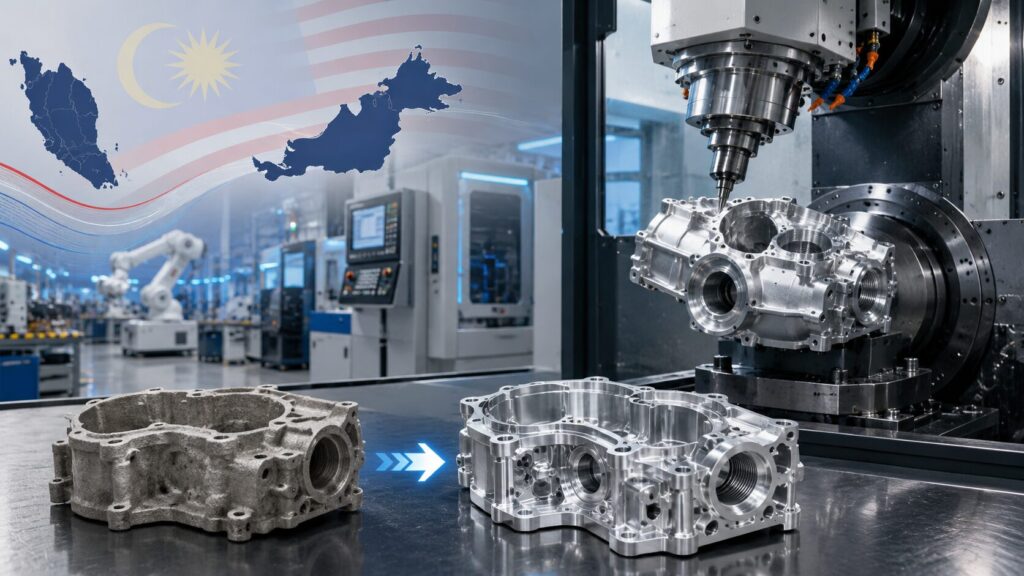
If you are managing a modern supply chain for electric vehicles (EVs), consumer electronics, or industrial automation, you already know the production math: high-volume manufacturing requires speed, scalability, and predictable costs.
High-pressure die casting is the undisputed go-to method for churning out complex metal parts rapidly. However, raw casting has its limitations. When your design blueprints require ultra-precise dimensions, perfect threads, or flawless sealing paths, raw castings often fall just short of the mark.
To bridge this gap, top-tier engineering projects pair structural volume with subtractive precision. Combining high-volume casting with specialized post-cast CNC machining in Malaysia is becoming the premier strategy for global brands. Here is why Malaysia has evolved into the ultimate production hub for high-precision aluminium die casting parts.
1. The “All-in-One” Production Hub
A classic headache for procurement managers is fragmented logistics. Shipping raw cast parts from a foundry in one country to a completely separate CNC machine shop in another creates major bottlenecks. It adds transit lead times, increases the risk of part damage during transport, and invites frustrating “blame games” between vendors if a batch fails quality control.
Malaysia’s premier industrial corridors, specifically across Penang, Selangor, and Johor have eliminated this problem. Top local manufacturers operate as fully integrated, one-stop facilities.
When a single engineering vendor controls the entire pipeline from the initial mold layout to final surface treatments, lead times drop dramatically. If a tolerance issue arises during the CNC phase, the machining team can instantly sync with the casting floor to correct the mold parameters. No friction, no finger-pointing.
2. Advanced 5-Axis Tech & Strict Quality Control
As industries like automotive EV lightweighting and telecommunications demand more compact designs, components require increasingly complex geometries. Thin walls, deep cavities, and tight internal threads cannot be formed by a mold alone.
Malaysian precision shops have invested heavily in advanced 4-axis and 5-axis CNC machining centers. These machines cut multi-angled surfaces in a single setup, preventing the orientation errors common with older, multi-step setups.
| Metric | Raw Aluminum Die Casting | Post-Cast CNC Machining |
| Achievable Tolerances | Around $\pm 0.1 \text{ mm}$ to $\pm 0.2 \text{ mm}$ | Down to $\pm 0.005 \text{ mm}$ |
| Ideal Structural Features | General enclosures, outer shapes, ribbing | Precision bore holes, mating faces, O-ring grooves |
| Surface Finish Value | Standard matte texture | Polished, sub-micron smooth finish |
Crucially, these shops back their hardware with rigorous quality control. Rather than relying on simple manual checks, components undergo comprehensive automated testing. Technicians utilize Coordinate Measuring Machines (CMM) for structural mapping and advanced X-ray imaging to flag hidden internal air bubbles (porosity) before parts are packaged and shipped.
3. A Reliable “China + 1” Alternative
Geopolitical stability and risk mitigation dominate supply chain strategy. Relying on a single manufacturing source leaves companies vulnerable to unexpected tariff spikes, regional lockdowns, or shipping channel bottlenecks.
As global operations actively implement “China + 1” strategies to build operational safety nets, Malaysia stands out as a highly stable, neutral partner. Backed by excellent shipping lanes, modernized port infrastructures, and established free trade agreements, local factories ensure your components clear export hurdles smoothly and arrive on time in Western and Asian markets alike.
4. Zero Language Barriers & Strong IP Protection
Miscommunication during the Design for Manufacturing (DFM) phase is one of the leading causes of scrapped production runs. A misunderstood note on a 3D CAD drawing can delay a product launch by weeks.
- Seamless Communication: Because English is the standard language within Malaysia’s engineering and corporate sectors, technical discussions are straightforward. Toolpath revisions, T1 sample feedback, and blueprint adjustments are handled clearly and quickly via email or video calls.
- Secure Engineering Assets: Protecting proprietary data is a critical concern when outsourcing. Malaysia operates under a robust, Western-aligned legal framework that strictly enforces intellectual property (IP) protection. Your 3D CAD files, custom CAM toolpaths, and proprietary part geometries remain entirely secure.
5. Greener Production (ESG Compliance)
International brands face strict mandates to minimize environmental impact across their supply chains. If your components are destined for European or North American consumer markets, tracking your carbon footprint is no longer optional.
Malaysian foundries are uniquely positioned to help brands hit these ESG goals. Local suppliers rely heavily on high-grade secondary (recycled) aluminum alloys. Transforming recycled scrap into production-ready alloy ingots requires roughly 95% less energy than raw bauxite mining.
When you pair green material choices with modern, energy-efficient CNC operations and closed-loop scrap recovery systems, your components automatically align with global sustainability requirements.
Real-World Impact: Seamless Supply Chain Transition
To see this ecosystem in action, consider the experience of a mid-sized consumer electronics brand that recently updated its supply chain:
Case Sharing: Cutting Overhead in Penang
A manufacturing group specializing in high-end optical sensors was struggling with a divided supply chain. They cast their aluminum housings at a high-volume foundry, but had to ship the components to an external workshop for precise sensor-bed machining. Inter-vendor communication gaps resulted in a persistent 4% reject rate due to surface scratches during transit.
By transferring the project to an integrated facility in Penang, the brand combined the casting and CNC steps under a single engineering team. The move completely eliminated transit damage, reduced their overall component manufacturing cycle by 18 days, and brought their final assembly defect rate down to zero.
The Takeaway
Shifting your precision component sourcing to Malaysia is a highly strategic move. By combining high-volume casting efficiency with state-of-the-art CNC precision, the local manufacturing ecosystem delivers the exact speed, quality, and supply chain security that modern hardware brands require.
Ready to streamline your hardware production? The best way to begin is by sharing your current 3D drawings with a technical partner for a comprehensive manufacturing assessment.